Carnivorous Pitcher Plant

one of the first plants in our swim pond
Wednesday, 29 February 2012
Snorkeling in the pond
Today has been very satisfying as the water level in the pool rises. It is now well over the filter and the pump is running. In fact it is almost up to the large step, within a few centimeters. The tank water has run out and we are now topping up with tap water.
To our surprise the water, which is crystal clear in a glass, has a brown almost greenish colour to it in the pool. We think this must be tannin staining from the vegetable matter in the first tank-probably also the source of the phosphates. That is not a problem for us since we are used to dam water which is tannin stained. There is a good chance this will fade with sunlight anyway. But it might make it difficult to see an algal bloom in it's early stages. The green colour might be reflection off the tree.
So today I was swimming, and even snorkeling, getting my submerged plants settled in. Happy as the proverbial pig......
If this was an aquarium I would expect a period of water deterioration before the biofilm and biofilter kick in. Perhaps a full on algal bloom. With our phosphate I wonder if this is what will happen?
Today there were three different dragon fly species hovering around the pool. There are also water boatmen (bugs) in the pool already. It is amazing how quickly the fauna are returning.
More pictures when the pool is full.


Filling the pool at last!
Well today was fill day. First we had to arrange the rocks in an aesthetically pleasing way, plant the steps area and install planters and jugs for plants around the pool edge. Then we had to await the lab test results for the water quality.
Our tank water turns out to have 0.056 mg/l of Phosphates. That sounds minuscule to me but Ralf says it is more than is desirable. We can use it but it might require some managing to keep the algae levels down. We may well have more algae (biofilm) around the walls and floor of the pool initially until the filters get the phosphates down.
However I am not dismayed at this. The increased biofilm will also allow insects to establish more quickly, (and thus their predators), tadpoles, snails and other algae eaters to establish etc. Even the newly planted plants will benefit from the phosphates, so that can't be all bad! As the pond develops more life it will develop an ecosystem of it's own and every thing will find a balance.
So after a Skype conference with Ralf we decided to go ahead and our tanks are draining into the pool as I write. We have enough water to more than half fill the pool and unless it rains tonight we will have to top up with town water.
And within 2 hours of starting the fill there was a tiny baby water dragon sitting on one of our decorative rocks, watching the rising water. So the fauna has started to move in already! I'm happy!
Monday, 27 February 2012
Pool conversion construction
The construction of the conversion is being completed by Andrew of Pool Planners, Brisbane. Ralf flew up from Sydney to supervise the filter intallation and Andrew, who is an experienced pool builder, is completing the refurbishment and completing the conversion.


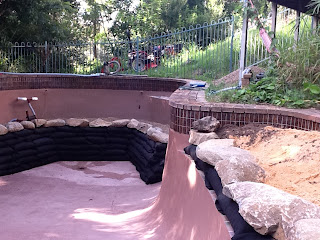

The filters are the long tubes and near them are bags of gravel which will be laid to form the retaining wall for the filter system.

Here the construction of the filter system has begun, with the first of the bag layers holding a gravel bed. All 6 units of the filter are laid on top in sequence and then further gravel is added.

This shot shows the landscaping of the step area where we will have lots of plants, and in the deep end you can see the filter system, with its bag wall and stone edging. The pool has also been painted.
Tomorrow is filling day hopefully, but first we have to complete the placement of soil and rocks and install some large pots over the filter area for our lotus and bull rushes, and other deep water plants. We are also awaiting the lab test results for our water tanks. We do want to use tank water to fill the pool if possible! It goes with our green ethos. Hopefully we'll have those results in the morning or the fill will be delayed!
Thursday, 23 February 2012
Animal list
The filling of the pool has been delayed by rain! The painting hasn't been completed, and we must wait a week for the curing of the paint before filling the pool. So I decided to document the animals we had in our pool before the current refurbishment.
We have seen:-
Eastern water dragons (Physignathus leuseurii),
Keelback snakes (the one that bit me and two more)
giant water beetles,
water striders,
whirligig beetles,
dragon flies and nymphs,
frogs - giant tree frog (litoria caerulea)
rocket frog (litoria leseurii),
desert tree frog (litoria rubella)
2 unidentified frogs.
Numerous tadpoles
A visiting egret,
A visiting wild duck (unidentified)
5 goldfish grew to giant size without feeding by us.
Birds bathing in the water - finches, honey eaters.
The cat and the dog drinking the water!
(toads -maybe I shouldn't mention that!)
We are installing a netting barrier around the pool to try to avoid toads but allow admission to all of the other creatures in the let above.
I wonder how long the new pool will take to re-establish it's fauna after filling?
Tuesday, 14 February 2012
Back on track
Well the do-it-yourself proccess didn't work for us! The water went green. The main problem for us was finding a way to get so many plants into the pool, with the water depth too high for most plants. The floating plants were not successful. However we did have a lot of life in the pool and we are more determined than ever to make this work.
So - plan B
We have contracted Ralf Schmeil from Gartenart in Sydney to install a biofilter. Ralf is very experienced in this sort of work and we feel confident with him. The process has started with the repair of the pool lining, installation of the filter bed, painting the pool a lovely pond brown, and installing hanging baskets and other planting areas around the pool.
The filling of the pool is scheduled for 1week's time. I have jumped the gun though and ordered a lotus! I can't wait!
So - plan B
We have contracted Ralf Schmeil from Gartenart in Sydney to install a biofilter. Ralf is very experienced in this sort of work and we feel confident with him. The process has started with the repair of the pool lining, installation of the filter bed, painting the pool a lovely pond brown, and installing hanging baskets and other planting areas around the pool.
The filling of the pool is scheduled for 1week's time. I have jumped the gun though and ordered a lotus! I can't wait!
Sunday, 17 April 2011
rainwater
 Its a lovely rainy day today, and the rainwater from part of our roof runs into the pool. Nice fresh water. We did th during the drought when we had water restrictions. But this could cause problems if it rained heavily - diluting the pool chemicals and causing a green change. It also prompted frogs to call and get into the pool so we had dead frogs floating there.
And if the pool should run over then we had salt and other chemicals flowing over our garden and poisoning our soil.

But today with the pool overflowing Charles's little sister can happily sit in the water and the grand old fig tree behind the pool is gtting clean, fresh water into its soil.
But I will have to reduce the level once it stops raining so the skimmer can work.
Saturday, 16 April 2011
Eureka! - the idea forms
In about October last year I was bitten by a snake whilst cleaning out the skimmer box on our pool. The little bugger was hiding under the flap and got me on the finger! So I spent the next 6 hours in hospital being stuck by a multitude of needles to find out whether I had been envenomated. In the end we decided it was a Keelback. Not particularly venemous, and I had not been significantly envenomated.
However my enthusiasm for the pool subsided somewhat and I didn't do any more work on the pool for some months. Hence the pool was without chlorine.
 This gave the opportunity to a number of water dragons to frequent the pool, and dragon flies, and water beetles. Watching this from our deck started to be quite a pleasure and the water dragons became quite tame. Emma has named the largest one "Charles" since we are sure that his namesake (Darwin) would have appreciated his beauty.

 We have also added floating plants. We have used a floating ring of plastic tubing to hold them together in a raft. We hope the root system might be a haven for insects and fish (when we put them in), as well as giving us plants in a place other than the step. They should also be taking nutrient out of the water and helping to keep it clear. The greenish look of the water in this picture is deceiving. It is actually very clear, but there is a growth of algae on the walls of the pool. In this pictre it makes the water look green but you can see that the blue hose is visible even though it is submerged.
 The look of the pond is very important to me. The pool is very cose to the house as you can see in this picture. We look down onto the pool from our new decks (2 levels). This is both a great advantage and should make for close observation of the developing flora and fauna, and a risk should things not go as planned.
 This morning when I got into the pool to add a few more plants I found 2 dragon fly nymph skins on the plants. This means that dragon fly nymphs have crawled up the plants to hatch out their dragon flies! We have seen the nymphs on the sides of the pool and have also seen drowned dragon flies. Presumaby they had no way of climbing out to emerge. Now that we have added the plants they can complete their life cycle and emerge succesfully. That gives me a great feeling of success! Also ths morning I saw a dragon fly dipping its tail into the water in our floating plant raft. I suppose this is egg laying. Dragon fly nymphs are voracious hunters and eaters of mosquito larvae, so all of this is very good news.
In about October last year I was bitten by a snake whilst cleaning out the skimmer box on our pool. The little bugger was hiding under the flap and got me on the finger! So I spent the next 6 hours in hospital being stuck by a multitude of needles to find out whether I had been envenomated. In the end we decided it was a Keelback. Not particularly venemous, and I had not been significantly envenomated.
However my enthusiasm for the pool subsided somewhat and I didn't do any more work on the pool for some months. Hence the pool was without chlorine.
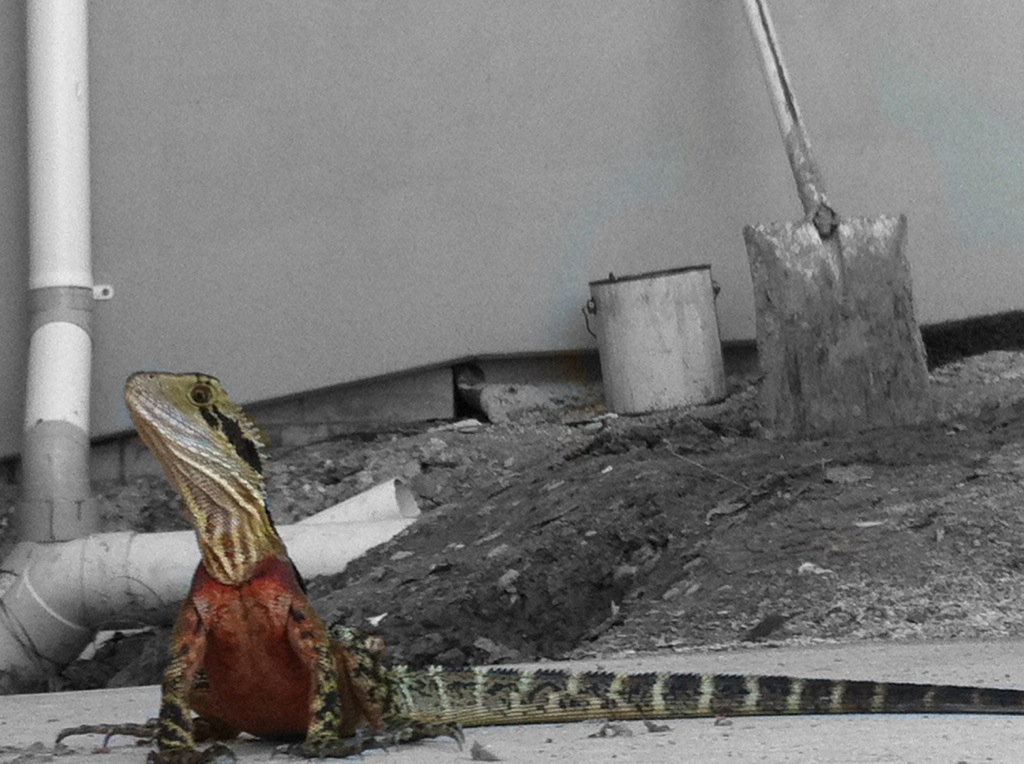 This gave the opportunity to a number of water dragons to frequent the pool, and dragon flies, and water beetles. Watching this from our deck started to be quite a pleasure and the water dragons became quite tame. Emma has named the largest one "Charles" since we are sure that his namesake (Darwin) would have appreciated his beauty.
So now we don't want to add chlorine which would possibly kill but certainy repel our new friends. This caused me to start searching for an alternative management system for the pool. In fact "natural swimming pools" are quite well known in Europe. They use biological filtration in a way similar to that used in an aquarium. This is accomplished by the work of bacteria on gravel filters and on the roots of plants. The result is sweet water that can sustain plants and a complex ecosystem of insects, frogs and even fish!
It is possible to have a pond with all this life as well as clean clear water good enough to swim in!
Our plan is to start adding plants, and as the weather warms up add a tub of gravel and reeds on the edge of the pool. Water will be pumped through the reed bed and fall back into the pool. This will make a water feature/water fall as well as a filtering sytem for the pool water. It is possible to clean the water with plants alone but we would need to cover half of the pool suface with pants and it still might not be enough. The external filter will increase the filtering capacity and allow us to plan and distribute the plants aesthetically.
The water is currenty very clear so we feel there is no urgency to add the filtering system. The weather has already cooled off for autumn so we won"t be swiming for a few months.
The beginning
So we have simply started adding plants!

The step is the obvious place to start. We have some old plastic crates to stand the plants on at the right depth.
Some of them we have bedded into gravel. Last week we visited a hydroponics shop and found some clay beads used to hold plants in that systm. We thought they might work well in our situation, providing bedding for the plants as well as a porous surface area for bacteria to inhabit. But they float! Joe found that heating them in the microwave before plunging them into cold water causes them to sink. Presumaby they absorb the water to some extent. However they are not very heavy and the pots need added stones to keep them securly grounded on the stands in the water.
The stands are quite visible which is not so aesthetialy pleasing. I think I will add a covering of shade cloth to reduce their visibility
 We have also added floating plants. We have used a floating ring of plastic tubing to hold them together in a raft. We hope the root system might be a haven for insects and fish (when we put them in), as well as giving us plants in a place other than the step. They should also be taking nutrient out of the water and helping to keep it clear. The greenish look of the water in this picture is deceiving. It is actually very clear, but there is a growth of algae on the walls of the pool. In this pictre it makes the water look green but you can see that the blue hose is visible even though it is submerged.
.
 The look of the pond is very important to me. The pool is very cose to the house as you can see in this picture. We look down onto the pool from our new decks (2 levels). This is both a great advantage and should make for close observation of the developing flora and fauna, and a risk should things not go as planned.
 In the photo you can see how close the pool is to the decks. The pool fence in this shot is temporary. The decks have just been completed and the builders have not yet restored the final fence. For my American friends - pool fences are compulsory in Austalia. Drowning is the mot common cause of death in infants - we have so many home pools and dams. So we just have to put up with the fences.
We also do not have our clothes line back yet. - the clothes on the deck are temporary!
Yesterday we went to a gardening expo and spoke with a pond equipment salesman. He told us that this hasn't been done in Brisbane before!!!!!! I do suppose he meant by his company. He said they had done 4 natural swimming ponds in southern states but not in Brisbane. He seemed a bit fearful that the climate might make it too difficult! However he did tell us about his filtration system (biological) which we could install if all else fails, for about $4000. That is great news. Even though this is quite a significant cost, there will be savings made by not adding chemicals to the pool. and not running the pool pump. We will need some electricity for the filtration system but a fraction of the previous power needs. Oh well- we are not new to bucking the system so here we go again!
The wild life is breeding!
 This morning when I got into the pool to add a few more plants I found 2 dragon fly nymph skins on the plants. This means that dragon fly nymphs have crawled up the plants to hatch out their dragon flies! We have seen the nymphs on the sides of the pool and have also seen drowned dragon flies. Presumaby they had no way of climbing out to emerge. Now that we have added the plants they can complete their life cycle and emerge succesfully. That gives me a great feeling of success! Also ths morning I saw a dragon fly dipping its tail into the water in our floating plant raft. I suppose this is egg laying. Dragon fly nymphs are voracious hunters and eaters of mosquito larvae, so all of this is very good news.
Please do comment if you want to. I could do with technical comments or just your thoughts about all of this. Do you think we are mad? Mind you this is all reversible. If we change our minds we can take the plants out, add chlorine and kill all of the wild life, reverting to normal operations. But we now have seen the vision of how things could be and would not want to go back. We are determind to make this work.
Subscribe to:
Posts (Atom)